
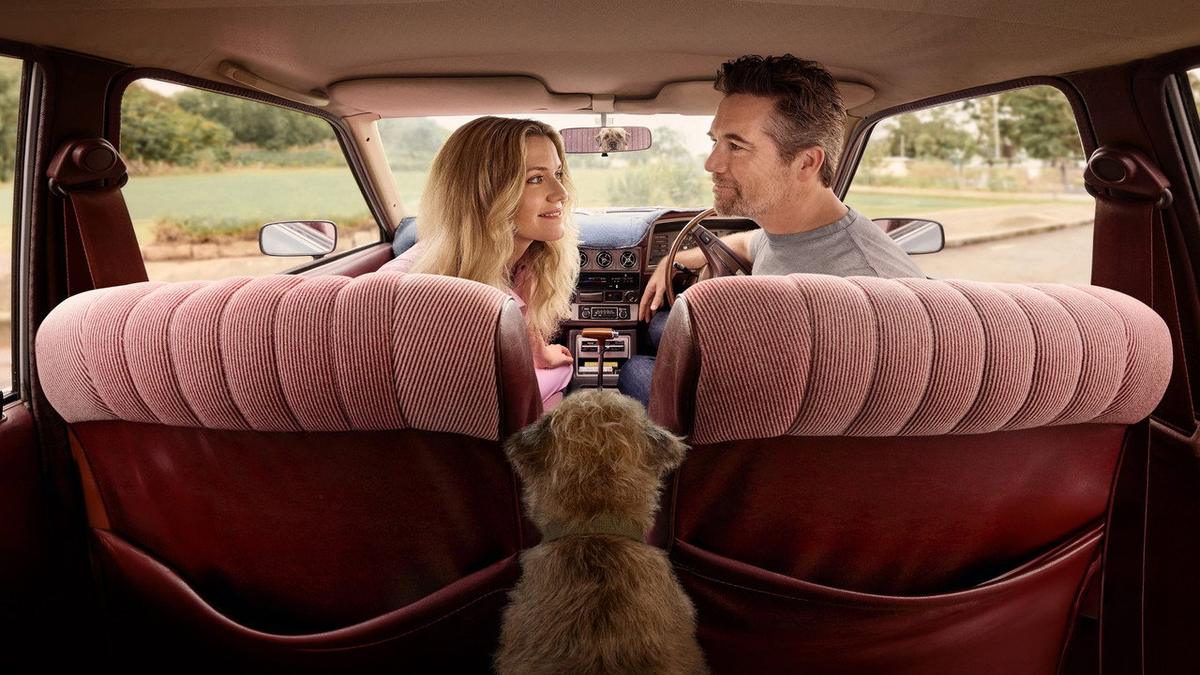
The meet-cute in modern romantic comedies is usually an exercise in glossy Hollywood contrivance: reaching for the same artisanal pastry, locking eyes across a subway platform, or bumping into each other in a bookstore.
In the premiere of the acclaimed Australian comedy Colin From Accounts, the meet-cute unfolds somewhat differently: 32-year-old medical student Ashley (Harriet Dyer) impulsively flashes her left breast to 44-year-old microbrewery owner Gordon (Patrick Brammall) as a thank-you gesture for letting her cross the road. Distracted by the unexpected sight of a nipple at 8:30 AM, Gordon accelerates his Subaru directly into a stray border collie.
Ten minutes later, two total strangers are standing inside an emergency veterinary hospital saddled with a paralyzed terrier, a pair of customized dog wheels, and an eye-watering \$12,000 medical debt.
Created by and starring real-life husband-and-wife duo Brammall and Dyer, Colin From Accounts (streaming on Paramount+, Binge, and the BBC) became an international sleeper hit not merely because of its charming canine namesake, but because of its unvarnished, pitch-perfect dialogue. Just as we analyzed the unique cultural codes driving locker room idioms in Ted Lasso and aristocratic class friction in our breakdown of The Gentlemen dialogue, Colin From Accounts offers a masterclass in modern Australian vernacular: self-deprecating, irreverent, and endlessly inventive.
For viewers outside Sydney trying to keep pace with Gordon and Ashley’s rapid-fire exchanges, here is the definitive guide to 10 hilarious Australian slang terms decoded for international audiences.
1. “A Proper Root”
- In the Show: Dropped casually in conversation when Ashley, Gordon, and their inner circle discuss dating misadventures, ex-partners, and questionable one-night stands.
- Literal Meaning: In Australia and New Zealand, “root” is one of the most common, coarse colloquialisms for sexual intercourse.
- The American Trap: To American viewers accustomed to “rooting for the home team” or “rooting through a backpack,” the term sounds completely wholesome. In Sydney, declaring that you spent your Sunday afternoon “rooting in the park” will result in stunned silence followed by immediate police intervention.
- The Comedic Context: Dyer and Brammall deploy the word with trademark Aussie casualness. In Colin From Accounts, sex is rarely romanticized; it is treated as a clumsy, absurd, and occasionally humiliating physical endeavor that people navigate between craft brewery shifts and veterinary checkups.
The Australian Law of Conversational Diminutives
Australian English is world-famous for truncating words and slapping an "-o", "-y", or "-ie" on the end (arvo, servo, bottle-o). But in romantic comedy dialogue, its real power lies in radical emotional deflation. The heavier the personal trauma, the more aggressively casual the vocabulary becomes.
2. “Fair Dinkum”
- In the Show: Uttered in exasperated disbelief by Gordon when looking at itemized bills for Colin’s specialized canine wheelchair, hydrotherapy sessions, and veterinary MRI scans.
- Literal Meaning: Truly, genuinely, honestly; the real deal.
- Cultural Context: Dating back to the 19th-century gold rushes (possibly derived from an old English dialect word dinkum meaning “fair work” or a fair share), “fair dinkum” is Australia’s foundational oath of truth. When phrased as a question (“Fair dinkum?”), it translates to: “Are you seriously telling me this is real?”
- The Comedic Context: In Colin, it serves as the ultimate reality check against modern urban pretension. Whenever a trendy Sydney character suggests a \$400 pet psychic or an artisanal raw-food canine diet, Gordon’s deadpan “Fair dinkum, mate?” immediately punctures the bubble.
3. “Having a Squiz”
- In the Show: Used when checking out Gordon’s eclectic craft brewery, inspecting Ashley’s chaotic shared apartment, or snooping through someone’s phone after a suspicious text notification.
- Literal Meaning: To take a quick, curious, or intrusive look.
- Dialect Lore: Originating in early 20th-century Australian and New Zealand slang, “squiz” is a delightful portmanteau blending “squint” and “quiz.” It conveys an informal, harmless noseyness—not formal surveillance, just a quick peek to see what someone is hiding in their pantry or dating app queue.
The Street Meet-Cute: The genius of the opening sequence is how it dismantles romantic comedy tropes in sixty seconds. Ashley's flash isn't glamorous seduction; it's a sleep-deprived, chaotic impulse. Gordon's reaction isn't smooth charm; it's total vehicular negligence. Their subsequent bond over Colin the dog is forged entirely in mutual embarrassment and financial panic.
4. “Chockers” (and “Choc-a-bloc”)
- In the Show: Gordon’s business partner Brett (Michael Hing) warning him about the Friday night crowd swarming the brewery, or Ashley describing the emergency ward after a suburban festival.
- Literal Meaning: Completely full; packed to maximum capacity; crowded to the gills.
- Cultural Context: Derived from naval terminology where tackle blocks were hoisted so close together that they touched (“chock-a-block”), Australians naturally shortened it to “chockers.” It is used equally for crowded Sydney trains, beer taprooms, or a stomach overloaded with pub chicken schnitzels.
5. “Bloody Legend”
- In the Show: Thrown around the bar when an employee covers an unexpected shift, when someone fetches an extra round of pale ales, or when Ashley successfully manages Colin’s manual bladder expression.
- Literal Meaning: A heroic, mythic figure.
- The Comedic Context: In Australia, “legend” is not reserved for war heroes or Olympic gold medalists. It is awarded for the most basic acts of human decency: finding someone’s lost house keys, splitting the Uber bill without making a spreadsheet, or agreeing to foster a crippled dog. Conversely, calling someone a “champ” in Australia is almost always a patronizing insult.
6. “Bogan”
- In the Show: Used self-consciously by characters examining their own lifestyle choices, questionable wardrobe purchases, or suburban childhood memories.
- Literal Meaning: An uncouth, unsophisticated person; the Australian equivalent of “redneck” or “chav,” though with distinct cultural warmth and pride.
- Cultural Context: The bogan archetype is central to Australian comedy. Gordon spends half the series worrying that his hipster flannel shirts and artisanal hazy IPAs are merely a thin veneer disguising his inner suburban bogan tendencies, creating endless comedic friction between his gentrified present and unpolished past.
7. “Spit the Dummy”
- In the Show: When Ashley’s overbearing mother Lynelle (Helen Thomson) or an unreasonable brewery patron throws a theatrical, irrational temper tantrum over a minor inconvenience.
- Literal Meaning: In Australia, a baby’s pacifier is called a “dummy.” To “spit the dummy” means to eject your pacifier and throw a childish, uncontrollable screaming fit.
- The Comedic Context: It is one of the most effectively humiliating phrases in the English language because it instantly reframes an adult’s righteous anger as the tantrum of a diaper-wearing toddler. Whenever someone in Colin loses their cool, someone inevitably whispers: “Careful, he’s about to spit the dummy.”
8. “No Worries” (The Passive-Aggressive Spectrum)
- In the Show: Deployed by Ashley and Gordon across dozens of awkward dating moments, financial negotiations, and roommate clashes.
- Literal Meaning: “You’re welcome” or “It’s not a problem.”
- The Comedic Subtext: While international audiences view “no worries” as the ultimate emblem of laid-back Aussie cheerfulness, Colin From Accounts showcases its dark underbelly. When delivered with a tight jaw, dead eyes, and a sharp upward inflection, “No worries at all!” actually translates to: “I will resent you for this until the day I die.”
The Australian Vernacular Paradox
In American sitcoms, romantic leads express vulnerability through earnest, heartfelt monologues. In Australian comedy, vulnerability is terrifying. Brammall and Dyer's characters express affection almost exclusively through mutual teasing, blunt self-deprecation, and shared exasperation at their own flaws.
9. “Tell Him He’s Dreaming”
- In the Show: Quoted with relish when veterinary surgeons present five-figure invoices or when pretentious landlords demand extortionate security bonds.
- Literal Meaning: The price or expectation is absurdly unrealistic.
- Cultural Lore: This phrase holds sacred status in Australian pop culture, popularized by the 1997 comedy classic The Castle, where patriarch Darryl Kerrigan browses the trading post and dismisses overpriced secondhand goods with the iconic line: “Tell him he’s dreaming.” In modern Australia, it is the mandatory verbal response to any ridiculous quote or invoice.
10. “Cactus”
- In the Show: Diagnosing mechanical engine breakdowns in Gordon’s car, shattered smartphone screens, or the grim physical state of Colin’s rear legs before his wheeled cart arrives.
- Literal Meaning: Broken, dead, unusable, or completely ruined.
- The Comedic Context: To say something is “cactus” is to accept its demise with cheerful finality. There is no point panicking or mourning; the thing is simply dead. When Ashley inspects a piece of broken veterinary gear and sighs, “Yep, she’s cactus,” it captures the pragmatic, laugh-through-the-ruins spirit that makes the show so endearing.
The Secret to Colin’s Global Heart
The global success of Colin From Accounts proves a universal comedic truth: specificity breeds authenticity. By refusing to soften their Sydney accents or sanitize their colloquialisms for international export, Patrick Brammall and Harriet Dyer created a romantic comedy that feels refreshingly real, chaotic, and relentlessly funny.
Underneath all the crude slang, awkward blushes, and wheel-assisted dog walks, Colin captures the terror and joy of two damaged people realizing that life rarely goes according to plan—and that sometimes, the best thing you can do when everything goes “cactus” is laugh, grab a beer, and keep rolling forward.