
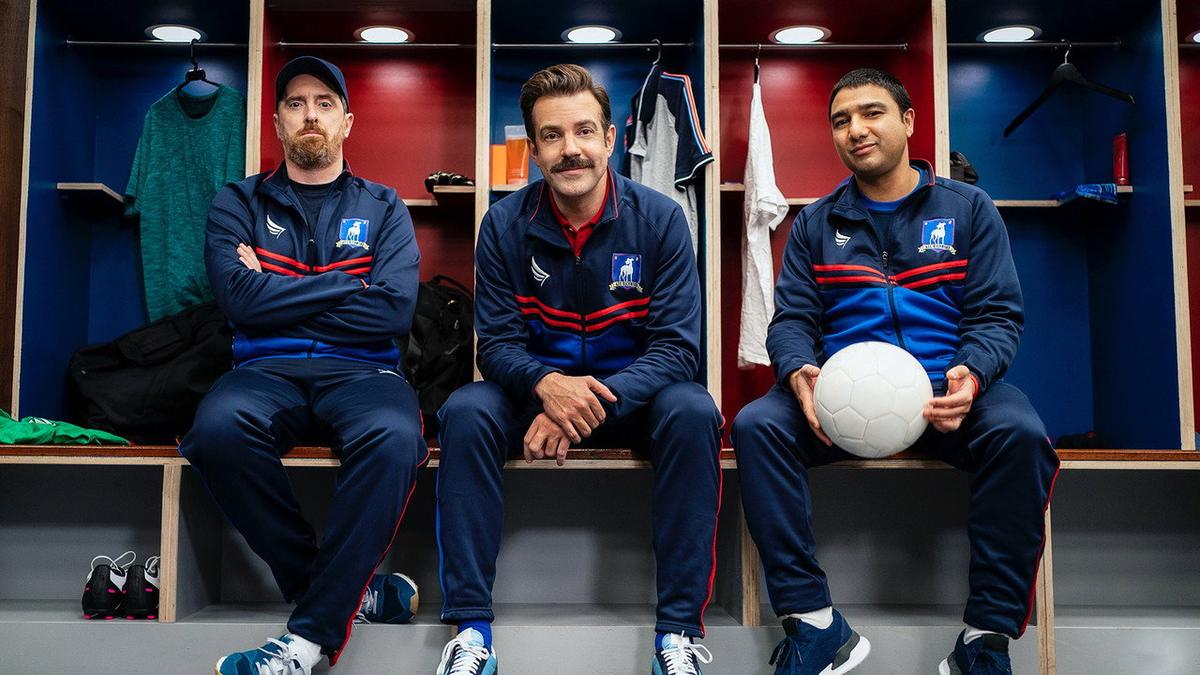
When Jason Sudeikis’s folksy, mustache-sporting American football coach landed at Heathrow Airport in the series premiere of Ted Lasso, he was equipped with infinite Midwestern warmth, an encyclopedic knowledge of Kansas barbecue, and absolutely zero understanding of the English linguistic minefield awaiting him.
Across three acclaimed seasons on Apple TV+, Ted Lasso was celebrated for its subversion of toxic sports culture and its radical empathy. But beneath the heartfelt speeches and biscuit deliveries to Rebecca Welton’s office, the show is one of the sharpest transatlantic comedies of manners ever filmed. Much of its comedic genius relies on the daily friction between Ted’s sunshine-pumped American colloquialisms (“tickle my pickle,” “sweeter than sweet tea”) and the sharp, sarcastic, and emotionally guarded vernacular of British football culture.
While we previously explored how British class warfare dictates high-society and underworld banter in our breakdown of posh phrases and gangster slang in The Gentlemen, Ted Lasso operates in an entirely different social arena: the chaotic, multicultural, working-class sanctuary of a Premier League locker room and the neighborhood pub.
To help American viewers navigate the rapid-fire insults, dressing-room ribbing, and pub chatter of Nelson Road, here is the definitive decoder for 15 essential British slang words in Ted Lasso.
1. “Wanker”
- In the Show: The very first word shouted at Ted the second he steps outside Richmond green, later chanted in rhythmic unison by 25,000 furious fans at Nelson Road stadium.
- Literal Meaning: A person who masturbates.
- The Comedic Context: In American television, the term is frequently treated as a quaint, harmless British quip. In the UK, it is an iconic, multi-purpose insult used to deflate arrogance, self-importance, or general incompetence. Ted’s revolutionary comedic move is stripping the word of its venom—he accepts it with a grin, signs autographs for fans chanting it, and eventually turns it into an ironic term of affection when the pub regulars realize he actually cares about the team.
- Dialect Note: The physical gesture accompanying it—a loose fist pumped vigorously in midair—is practically Britain’s unofficial national salute.
The Ted Lasso Linguistic Inversion
In traditional British comedy, cynical insults crush optimistic characters. In Ted Lasso, optimism is weaponized to disarm insults. By treating "wanker" as a friendly greeting, Ted denies cynical Londoners the satisfaction of watching him crumble.
2. “Bants” (and “Top Bants”)
- In the Show: Jamie Tartt (Phil Dunster) and Colin Hughes (Billy Harris) justifying cruel practical jokes, locker room hazing, or humiliating kitman Nate (Nick Mohammed).
- Literal Meaning: Short for “banter”—playful, witty, teasing conversation.
- The Comedic Context: The writers use “bants” as a razor-sharp critique of British lad culture. In the modern UK sports vernacular, labeling cruelty as “just a bit of bants, mate” is the universal get-out-of-jail-free card for obnoxious behavior. One of Ted and Roy Kent’s earliest cultural victories is dismantling this excuse and teaching the squad the difference between affectionate bonding and toxic mockery.
3. “Chuffed”
- In the Show: Director of Football Leslie Higgins (Jeremy Swift) beamed with pride after booking a jazz gig, or Ted trying out the word to describe his modest coaching breakthroughs.
- Literal Meaning: Delighted, pleased, or genuinely proud of an achievement.
- The Comedic Context: “Chuffed” is one of those quintessentially cuddly northern and colloquial English terms that sounds almost cartoonish to American ears. The comedic contrast peaks when someone like Higgins uses it with puppy-dog sincerity, compared to Roy Kent (Brett Goldstein), whose face physically contorts in agony if he ever has to admit he is “chuffed” about anything.
- Sub-variant: Watch out for “chuffed to bits,” which means ecstatic, versus the obscure Northern variant “dischuffed,” which means annoyed.
4. “Boot” (Cleats vs. Car)
- In the Show: Constant comedic confusion between Ted, Coach Beard (Brendan Hunt), and the equipment staff during training sessions.
- Literal Meaning: In British football parlance, “boots” are what Americans call soccer cleats. In automotive terms, the “boot” is the vehicle’s trunk.
- The Comedic Context: The writers milk the dual meaning for classic transatlantic miscommunication. When Roy threatens to put his “boot up someone’s arse,” Ted has to pause and calculate whether Roy is referencing footwear or vehicular manslaughter.
The Anatomy of the Roy Kent Growl: Roy Kent’s vocabulary consists of roughly 40% profanity, 30% tactical positioning terminology, and 30% guttural growls. His dialogue demonstrates the British art of emotional economy: where Ted uses a 400-word Midwestern allegory to explain patience, Roy communicates the exact same sentiment with a monosyllabic glare and a well-placed "F***ing hell."
5. “Knackered”
- In the Show: Spoken by players collapsing onto the turf after Roy Kent implements his brutal conditioning drills, or by Coach Beard after an all-night underground rave.
- Literal Meaning: Completely exhausted, worn out, or broken beyond repair.
- Cultural Context: The term originates from the 19th-century “knacker’s yard”—a slaughterhouse where old, injured, or exhausted workhorses were put down and processed for glue and tallow. Today, it is harmless, everyday British shorthand for being physically or mentally drained after ninety minutes on the pitch.
6. “Gutted”
- In the Show: Used by pub regulars Baz, Paul, and Jeremy whenever AFC Richmond concedes a stoppage-time goal to blow a 1-0 lead.
- Literal Meaning: Devastated, heartbroken, or bitterly disappointed (evoking the visceral imagery of having one’s internal organs scooped out).
- The Comedic Context: “Gutted” is the definitive emotional frequency of British football fandom. Unlike American sports fandom, which often swings between irrational championship hype and furious radio call-in meltdowns, English football culture is built on a foundation of resigned, generational melancholy. To be “gutted” is not a surprise; it is the default state of existence.
7. “Proper Charlie” (and “Pillock”)
- In the Show: Keeley Jones (Juno Temple) or Rebecca Welton (Hannah Waddingham) affectionately dressing down Ted or Jamie when they embarrass themselves in public.
- Literal Meaning: A fool, an idiot, or someone who has made a spectacular mess of things.
- Cultural Context: “Proper Charlie” is classic Cockney rhyming slang dating to the mid-20th century (often linked to rhyming “Charlie Dilke” or “Charlie Smirke”). It is a gentle, almost endearing insult. “Pillock,” on the other hand, dates back to 16th-century dialect for a penis, though in modern British parlance it sits comfortably alongside “plonker” and “muppet” as a mild reprimand for boneheaded behavior.
8. “Taking the Piss”
- In the Show: Roy Kent’s immediate response whenever Ted suggests yoga, meditation, team-building charades, or communal crying sessions.
- Literal Meaning: To mock, deride, or fail to take a serious situation with appropriate gravity.
- The Comedic Context: The entire culture clash of Ted Lasso hinges on this phrase. In the UK, taking the piss is the air people breathe; it is the universal social lubricant. Ted, who comes from a Midwestern culture where earnestness is sacred and sarcasm is suspect, constantly has to calibrate whether someone is testing his boundaries or simply saying hello.
9. “Nutmeg” (or “Megs”)
- In the Show: Celebrated with wild shrieks and mock brawls during training sessions when Dani Rojas (Cristo Fernández) or Jamie slips the ball cleanly through an opponent’s open legs.
- Literal Meaning: Kicking or rolling the ball between a defender’s legs and collecting it on the other side.
- Cultural Context: In soccer subculture, getting nutmegged is considered the ultimate public humiliation—a trick that strips a defender of their dignity. The etymology dates back to Victorian slang, where “nutmegs” referred to a person’s testicles, while also referencing export fraud in the spice trade where wooden replica nutmegs were slipped into shipments to con buyers.
10. “A Doddle”
- In the Show: Mae (Annette Badland), the fiercely maternal proprietor of The Crown & Anchor pub, evaluating an upcoming match against a lower-league cup opponent.
- Literal Meaning: An extraordinarily easy task; a walk in the park; a piece of cake.
- The Comedic Context: In the dramatic irony of sports television, whenever a British character confidently declares an upcoming match to be “an absolute doddle,” disaster is guaranteed. It is the verbal equivalent of an American horror movie character saying, “I’ll be right back.”
11. “Piss Off”
- In the Show: Roy Kent’s signature greeting, sign-off, tactical critique, and love language.
- Literal Meaning: Go away; leave immediately.
- The Comedic Context: In Brett Goldstein’s delivery, “piss off” achieves Shakespearean elasticity. It can communicate murderous rage, mild irritation, stunned disbelief, or—in rare, emotional moments with Keeley or his niece Phoebe—profound tenderness. The comedic brilliance lies in how the American characters, particularly Ted, refuse to be banished by it, responding to Roy’s harshest “Piss off” with a cheerily chirped “See ya tomorrow, Roy!”
12. “Minging”
- In the Show: Used by kitman-turned-coach Nate when describing stale shinguards, mud-caked socks, or Ted’s profound revulsion upon sipping English breakfast tea.
- Literal Meaning: Disgusting, foul-smelling, or aesthetically hideous (pronounced ming-ing, with a soft Scottish and Northern English origin).
- The Comedic Context: Ted’s running battle against British tea is one of the show’s longest-running running gags. To Ted, Earl Grey tastes like “hot brown water” and “a wet cardboard box.” To the Richmond locker room, leaving your sweaty training kit in a gym bag over the weekend is simply “proper minging.”
13. “Chirpy”
- In the Show: How Roy Kent and local journalists disdainfully describe Ted’s relentless morning cheerfulness before the sun has even burned through the London fog.
- Literal Meaning: Cheerful, lively, and talkative (like a singing bird).
- Cultural Context: In London, unprovoked cheerfulness before 9:00 AM is viewed with extreme suspicion, bordering on social hostility. When Roy snarls that Ted is “too f*ing chirpy,” he isn’t merely complaining about volume—he is expressing a philosophical objection to morning optimism.
The Pub as Cultural Classroom
The Crown & Anchor serves as the linguistic translator for the entire series. It is where working-class pub philosophy collides with modern corporate football. Mae and her three resident philosophers (Baz, Paul, and Jeremy) represent the chorus in a Greek tragedy—decoding the emotional state of Richmond one pint of bitter at a time.
14. “Throw a Spanner in the Works”
- In the Show: Higgins delicately explaining to Rebecca how an unexpected Premier League ruling, a rogue tweet from Jamie Tartt, or an interference from former owner Rupert Mannion (Anthony Head) ruins their weekly strategy.
- Literal Meaning: The British equivalent of the American idiom “throwing a monkey wrench into the gears”—sabotaging or disrupting a smoothly running operation.
- Cultural Context: In British English, an adjustable wrench is a “spanner.” The phrase dates to the Industrial Revolution in Northern textile mills, where dropping a metal spanner into intricate mechanical looms would seize the entire factory floor.
15. “Budge Up”
- In the Show: Spoken around the crowded wooden tables of the pub or on the team bus when another Richmond player needs to squeeze onto the bench.
- Literal Meaning: Make room; slide over; share the seating space.
- The Comedic Context: While deceptively simple, “budge up” embodies the communal, tight-knit intimacy of British pub culture and locker rooms. You don’t ask for personal space in English football; you tell someone to “budge up,” squeeze your shoulders together, and share the bench.
The Lasting Comedy of Transatlantic Translation
The lasting achievement of Ted Lasso’s writing room—led by Sudeikis, Brendan Hunt, Bill Lawrence, and Joe Kelly—was recognizing that language is not merely a vehicle for jokes; it is an index of vulnerability.
Ted didn’t conquer London by mastering its slang. He won over Richmond by understanding the emotional truths hidden behind the banter, the sarcastic barbs, and the stadium insults. When the Nelson Road faithful finally embraced their American manager, they didn’t stop calling him a “wanker”—they simply made sure he knew they meant it with love.